
Black holes! Supernovas! Merging galaxies! Oh my! Largest radio survey of the cosmos ever reveals 13.7 million powerful…
Space.com
by Robert Lea February 25, 2026
AI-Generated Deep Dive Summary
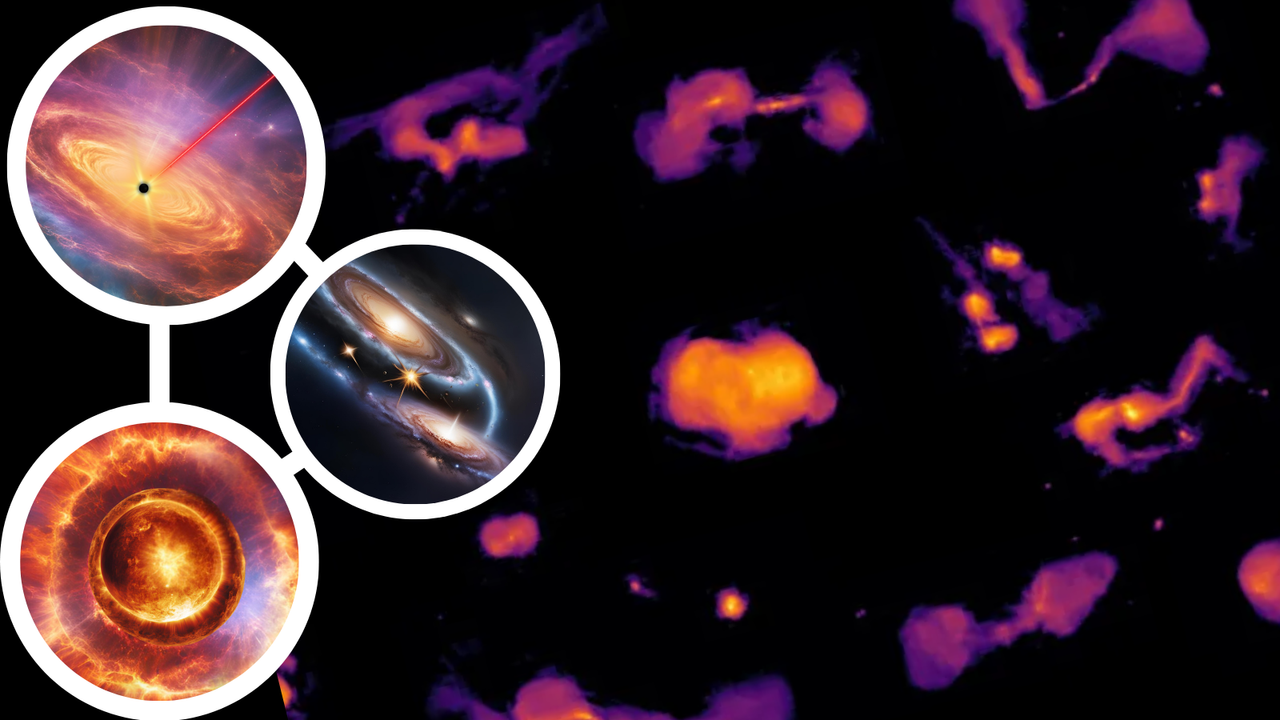
A groundbreaking radio survey of the cosmos, conducted using the Low-Frequency Array (LOFAR), has uncovered an unprecedented 13.7 million cosmic objects and events. This monumental dataset, known as LoTSS-DR3, provides a detailed view of phenomena such as supermassive black hole jets, galaxy collisions, and supernova explosions, all observed through the lens of radio waves. By leveraging LOFAR's unmatched sensitivity to low-frequency radio emissions, astronomers have revealed how these high-energy processes shape galaxies and influence cosmic evolution.
The survey highlights the powerful jets emitted by active galactic nuclei (AGNs), where supermassive black holes eject matter at relativistic speeds. These jets, driven by magnetic fields and accelerated particles, play a crucial role in shaping the surrounding environments of their host galaxies. Additionally, LoTSS-DR3 captures the dynamic processes of galaxy mergers and supernovae, offering insights into how these events accelerate particles to near-light speed and generate radio emissions.
One of the most significant findings is the ability to study the evolution of supermassive black hole jets across different stages. This reveals how their properties are influenced by both the black holes themselves and their galactic surroundings. The survey also provides a unique perspective on our own Milky Way, mapping its magnetic fields with unprecedented detail.
For researchers, LoTSS-DR3 represents a leap forward in understanding the universe's energetic processes. By analyzing millions of galaxies, astronomers can study how giant shocks and turbulence drive particle acceleration over vast scales. This knowledge not only deepens our understanding of cosmic dynamics but also offers clues about the rates of star formation and the interplay between black holes and their host environments.
This survey underscores the transformative power of radio astronomy. By shifting focus from visible light to longer wavelengths, scientists gain access to entirely new dimensions of cosmic phenomena. The findings from LoTSS-DR3 are not just a scientific milestone but also a gateway to future discoveries about the universe's most extreme events and its fundamental processes.
Verticals
spacescience
Originally published on Space.com on 2/25/2026