
Blazing ring of fire' eclipse seen from space | Space photo of the day for Feb. 20, 2026
Space.com
by Daisy Dobrijevic February 20, 2026
AI-Generated Deep Dive Summary
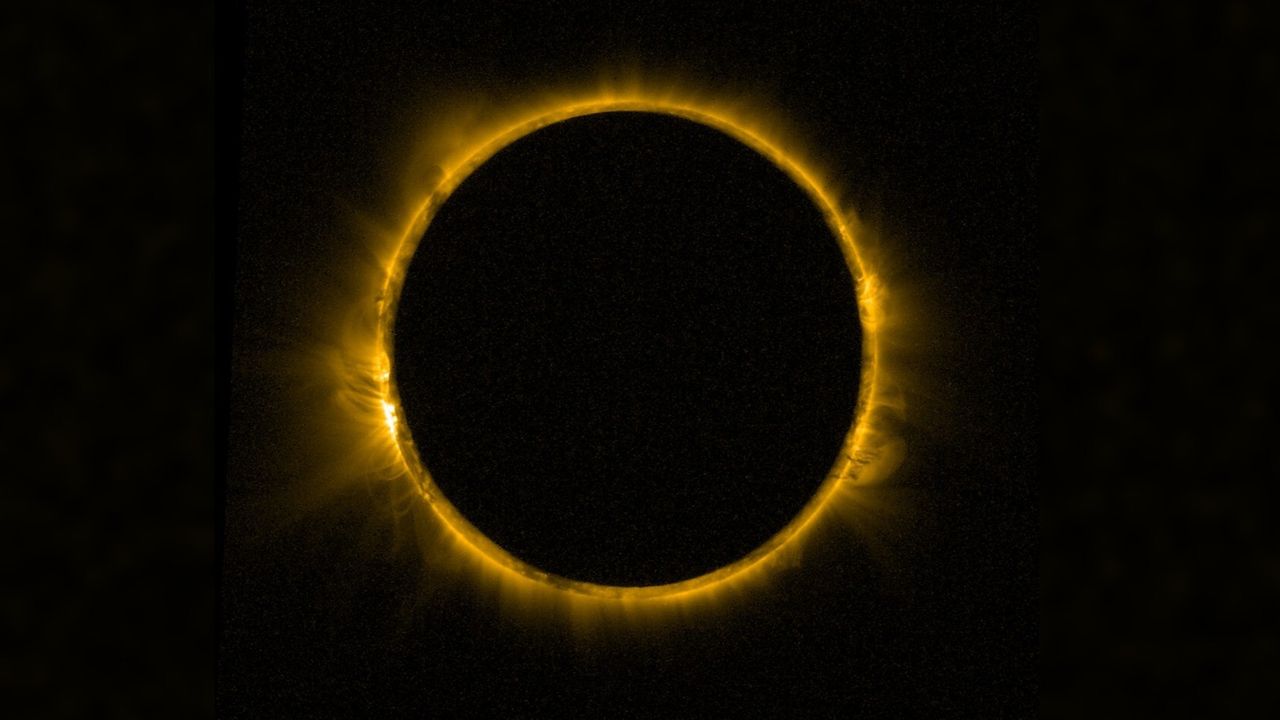
ESA's Proba-2 satellite captured a stunning 'ring of fire' annular solar eclipse from space on Feb. 17, 2026. Unlike the limited visibility on Earth, where only remote regions in Antarctica and parts of South America and Africa could witness the full spectacle, Proba-2 had an unobstructed view from orbit. The satellite observed the event four times during its orbit, including a perfect annular phase at 6:31 a.m. EST (1131 GMT), when the moon occulted over 93% of the sun's disk.
An annular solar eclipse occurs when the moon passes between Earth and the sun but appears smaller in the sky due to its distance from Earth, creating a bright ring of sunlight around its silhouette—the 'ring of fire.' Proba-2's SWAP instrument captured this phenomenon in extreme ultraviolet light, revealing intricate details of the sun's corona, or outer atmosphere. This perspective provided unique insights into solar activity that are typically inaccessible to ground-based observers.
While researchers in remote Antarctic locations and parts of Chile, Argentina, and southern Africa experienced partial eclipses, Proba-2's vantage point allowed it to witness the event from multiple angles due to its fast sun-synchronous orbit. This capability highlights the importance of space-based observations in studying solar phenomena with unparalleled clarity and detail.
The ability to observe such events repeatedly from different perspectives underscores the value of satellite missions like Proba-2 for advancing our understanding of the sun's behavior, which is crucial for predicting space weather and its impact on Earth. For space enthusiasts and researchers, these images offer a rare glimpse into the dynamic processes occurring in our solar system, making them invaluable for both scientific research and public engagement in astrotourism.
This event not only showcases the power of space exploration but also reminds us of the unique perspectives that satellites provide, allowing us to study celestial phenomena with greater depth and detail than ever before.
Verticals
spacescience
Originally published on Space.com on 2/20/2026