
Earliest known writing dates back over 40,000 years
Popular Science
by Andrew PaulFebruary 23, 2026
AI-Generated Deep Dive Summary
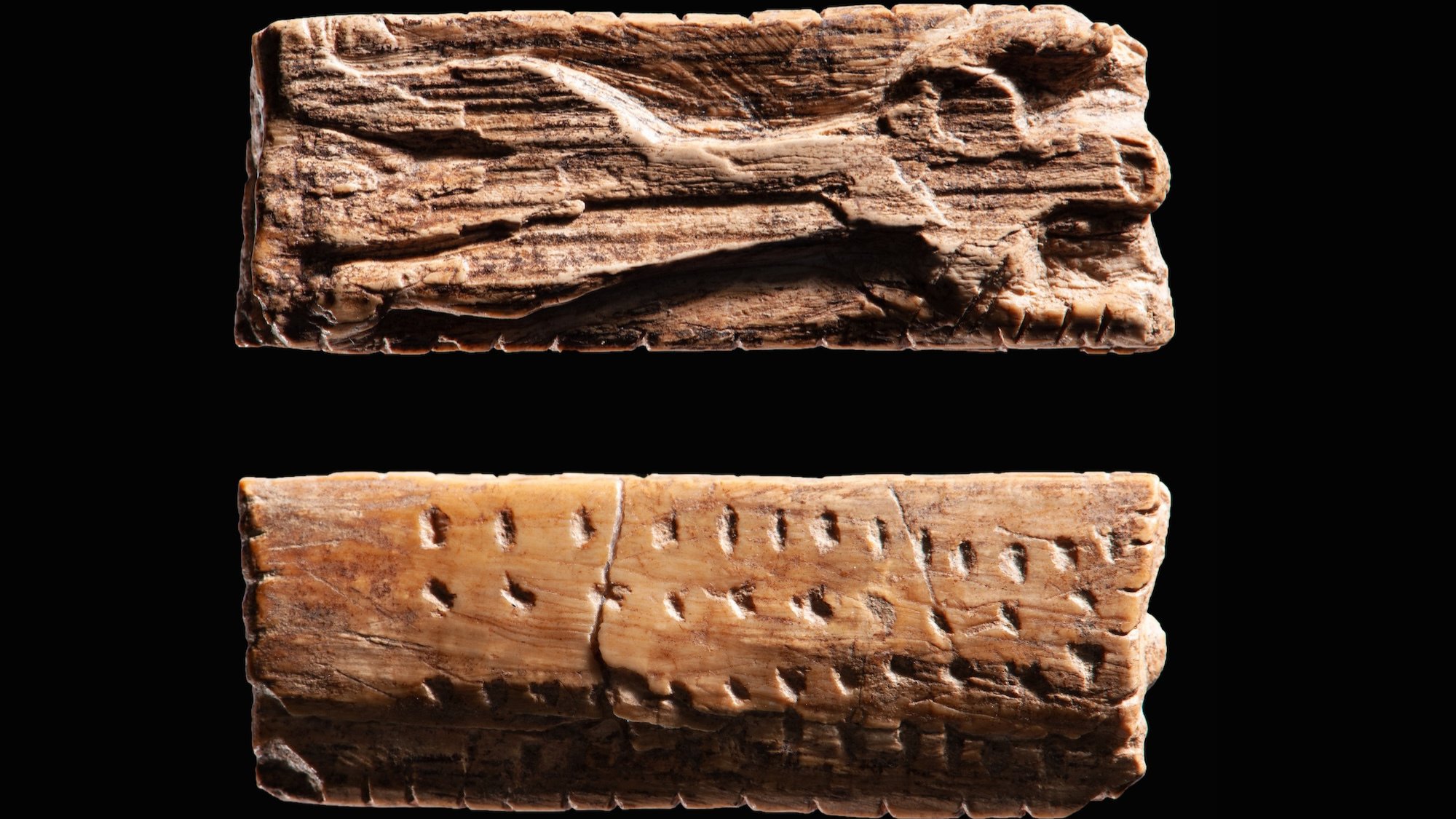
New evidence reveals that symbolic writing may have originated as far back as 40,000 years ago, significantly earlier than previously thought. This groundbreaking discovery was made by analyzing Stone Age artifacts from Germany, which feature intricate patterns of lines, crosses, dots, and notches. These findings challenge the long-held belief that the earliest known writing systems, such as Mesopotamian proto-cuneiform, emerged around 3000 BCE. Instead, researchers suggest that the ability to encode information through symbols evolved over tens of thousands of years, with early examples found on artifacts from the Swabian Jura region.
Among the artifacts studied are a small mammoth figurine carved from mammoth tusk and the Adorant, an ivory carving depicting a human-lion figure. These items, along with other similar relics, were meticulously analyzed using computational tools to compare their patterns with those of later writing systems, including cuneiform. While the exact meanings of these ancient symbols remain elusive, researchers noted that their repetitive nature suggests they served a symbolic or communicative purpose rather than representing spoken language.
The study also highlights the continuity in the evolution of writing systems. Despite the vast time gap between the Stone Age artifacts and later writing forms like cuneiform, certain characteristics remained consistent. This indicates that the fundamental principles of encoding information through symbols were established much earlier than previously understood. The findings not only reshape our understanding of human cognitive development but also emphasize the deep-rooted human impulse to create systems of communication.
This research underscores the complexity of early human societies and their capacity for abstract thought. By examining these ancient artifacts, scientists gain insights into the evolution of language and writing, which are fundamental to human culture and technological advancement. The discovery challenges conventional timelines and invites further exploration into the origins of human communication, offering a fascinating glimpse into our shared history.
For readers interested in science and technology, this breakthrough highlights how advancements in computational analysis are rewriting the story of human history. By bridging the gap between prehistoric times and modern systems, these findings not only deepen our understanding of early humans but also connect us to the very roots of human innovation. This research reminds us that the ability to encode information is a deeply ingrained aspect of human nature, one that has evolved over millennia.
Verticals
sciencetech
Originally published on Popular Science on 2/23/2026