
Hubble and Chandra space telescopes hunt for rogue black holes wandering through dwarf galaxies
Space.com
by Robert Lea February 19, 2026
AI-Generated Deep Dive Summary
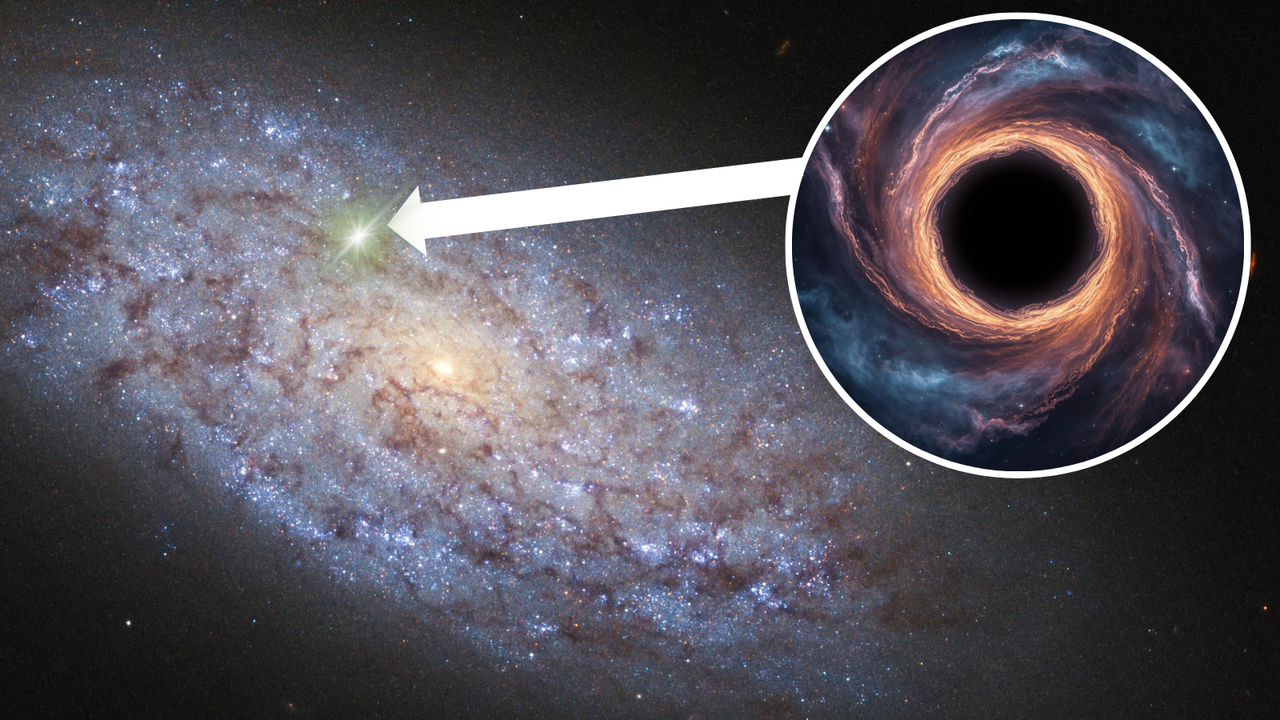
Astronomers using NASA's Hubble Space Telescope and Chandra X-ray Observatory are investigating "wandering" black holes in dwarf galaxies, a discovery that could shed light on how supermassive black holes grew to such enormous sizes early in the universe's history. Supermassive black holes, which are found at the centers of large galaxies, have been observed by the James Webb Space Telescope in galaxies dating back less than one billion years after the Big Bang. This raises questions about their formation, as processes like merging and accretion typically take longer than a billion years to produce such massive objects.
One theory is that supermassive black holes may have started with "black hole seeds," which provided an early advantage for growth. These seeds could be either "heavy" or "light," but identifying them in the early universe has proven challenging. Dwarf galaxies, particularly, are thought to host a significant number of these wandering black holes. Unlike massive galaxies where black holes tend to spiral into the center, dwarf galaxies have lower central stellar densities and irregular shapes, making it harder for black holes to move inward. Some researchers estimate that up to half of all black holes in dwarf galaxies may be wanderers.
To detect these rogue black holes, astronomers focus on active galactic nuclei (AGNs) in dwarf galaxies. AGNs are regions where black holes actively accrete material and emit intense radiation across the electromagnetic spectrum. However, identifying these AGNs is tricky because they can resemble other phenomena like starburst regions or supernova explosions. The team used multi-wavelength observations to distinguish compact radio emissions offset from the centers of 12 dwarf galaxies, suggesting that eight of them may host wandering black holes.
This research has significant implications for understanding black hole formation and evolution. If confirmed, it could reveal a "fossil record" of seed black holes that provided the starting point for supermassive black holes in large galaxies. This would help explain how these massive objects formed so quickly after the Big Bang and shaped the early universe's structure. For space enthusiasts and researchers alike, unraveling this mystery offers a deeper insight into the origins of black holes and the evolution of galaxies.
Verticals
spacescience
Originally published on Space.com on 2/19/2026