
Hubble telescope discovers rare galaxy that is 99% dark matter
Space.com
by Robert Lea February 19, 2026
AI-Generated Deep Dive Summary
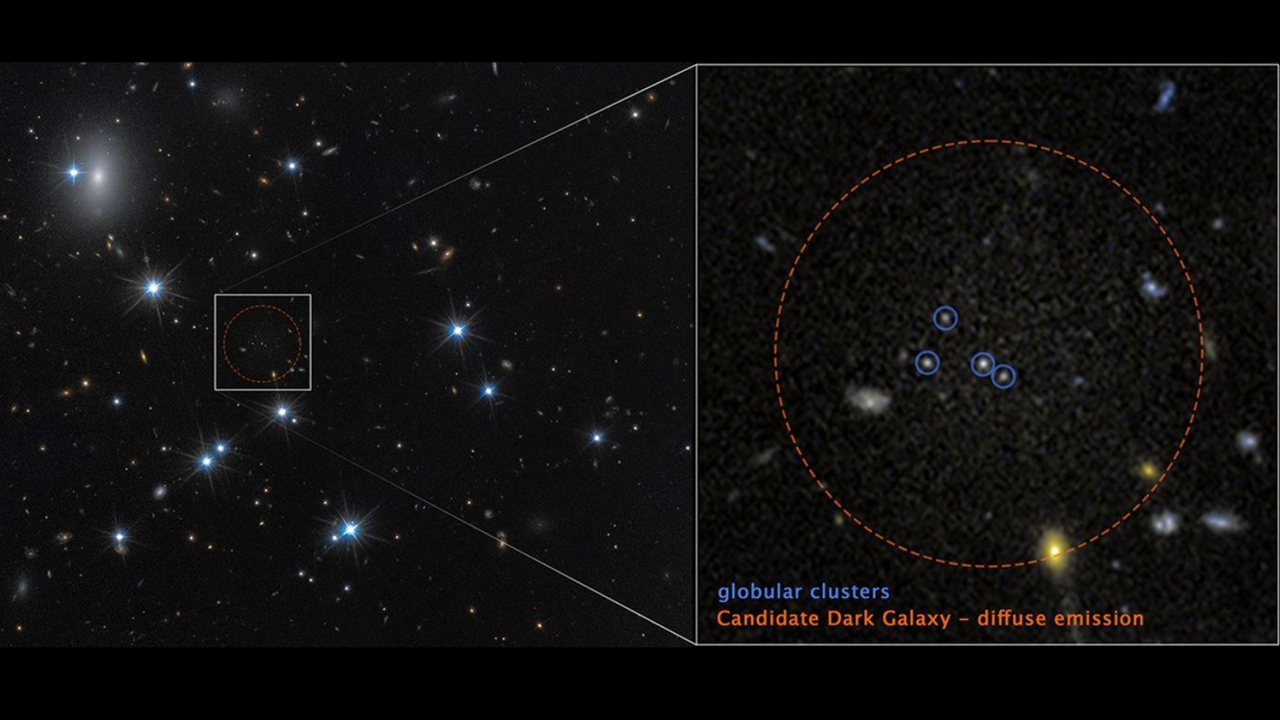
The Hubble Space Telescope has made a groundbreaking discovery: a galaxy named CDG-2 that is an extraordinary 99% dark matter. This rare find, located in the Perseus galaxy cluster about 300 million light-years away, represents one of the most extreme examples of a dark matter-dominated galaxy ever observed. Unlike typical galaxies where visible matter like stars and gas dominates, CDG-2’s faint glow reveals that its mass is overwhelmingly composed of invisible dark matter. This discovery marks the first time a galaxy has been detected solely through its population of globular clusters— dense groupings of stars that serve as indicators of hidden gravitational influences.
Dark matter, which makes up approximately 85% of the universe’s mass, does not emit or absorb light, making it notoriously difficult to detect. However, its presence is revealed through its gravitational effects on visible matter and surrounding galaxies. In CDG-2’s case, researchers identified four globular clusters near the galaxy, leading them to infer the existence of the faint, low-surface-brightness galaxy itself. Observations from Hubble, Euclid, and the Subaru Telescope confirmed the faint glow around these clusters, which corresponded to the dim galaxy. The galaxy’s brightness is equivalent to only 6 million sun-like stars, with just 16% of that light attributed to the overlying globular clusters.
The detection of CDG-2 highlights how dark matter influences galactic structure and evolution. Scientists believe that while normal matter in CDG-2 may have once supported star formation, much of it was stripped away through gravitational interactions with other galaxies. The galaxy’s sparse scattering of stars suggests it has been significantly disrupted over time, leaving behind a nearly invisible structure dominated by dark matter. This discovery not only sheds light on the nature of dark matter but also underscores how galaxies can exist in ways that challenge our understanding of visible and invisible cosmic components.
For readers interested in space science, this breakthrough matters because it provides new insights into the role of dark matter in shaping the universe. By studying such
Verticals
spacescience
Originally published on Space.com on 2/19/2026