
James Webb Space Telescope performs brain surgery on mysterious 'Exposed Cranium Nebula'
Space.com
by Keith Cooper February 26, 2026
AI-Generated Deep Dive Summary
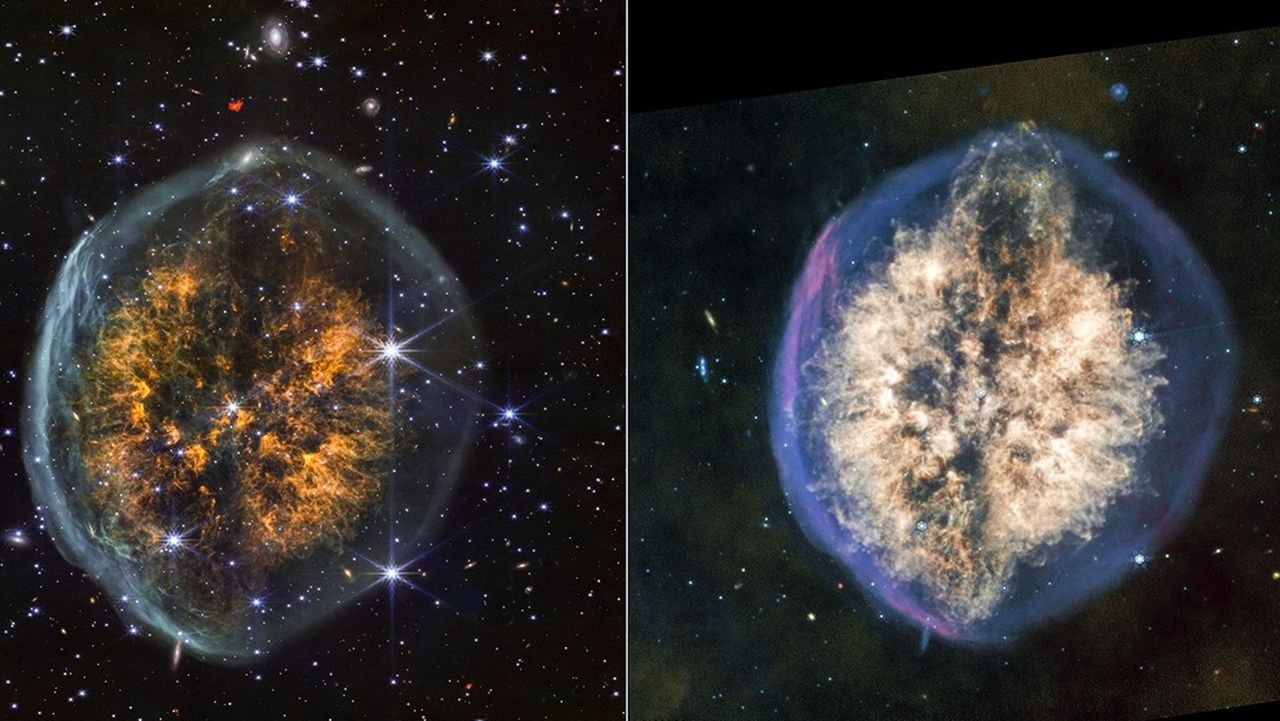
The James Webb Space Telescope has captured a stunning image of the Exposed Cranium Nebula, a dying star’s final stage that resembles a brain inside a transparent skull. Officially named PMR 1, this nebula is located 5,000 light-years away in the constellation Vela and was discovered in the late 1990s by astronomers Parker, Morgan, and Russell. Its nickname comes from its eerie resemblance to an exposed cranium, a feature that becomes even more apparent when viewed through the telescope’s infrared capabilities.
The nebula’s unique structure, with a split down the middle resembling left and right brain lobes, suggests it may have been shaped by polar jets from the central star. The outer shell of the nebula appears cooler compared to the inner ionized gases, which were likely expelled later in the star’s life. This intricate detail, revealed in the mid-infrared image, offers insights into how such structures form and evolve.
While the Exposed Cranium Nebula was initially thought to be associated with a Wolf-Rayet star—a massive, unstable type of star known for its intense radiation—this connection has yet to be confirmed. The nebula could also be an ordinary planetary nebula formed by a less massive star in its final stages of evolution, shedding its outer layers to expose a white dwarf core. This uncertainty highlights the complexity of stellar evolution and the challenges astronomers face in understanding these cosmic phenomena.
The image not only captures the beauty of space but also serves as a reminder of the delicate balance between life and death for stars. For readers interested in space, this story offers a glimpse into the mysteries of stellar evolution and the power of modern telescopes to reveal hidden wonders in our universe.
Verticals
spacescience
Originally published on Space.com on 2/26/2026