
Leaf tips glow blue in thunderstorms
Popular Science
by Laura BaisasFebruary 25, 2026
AI-Generated Deep Dive Summary
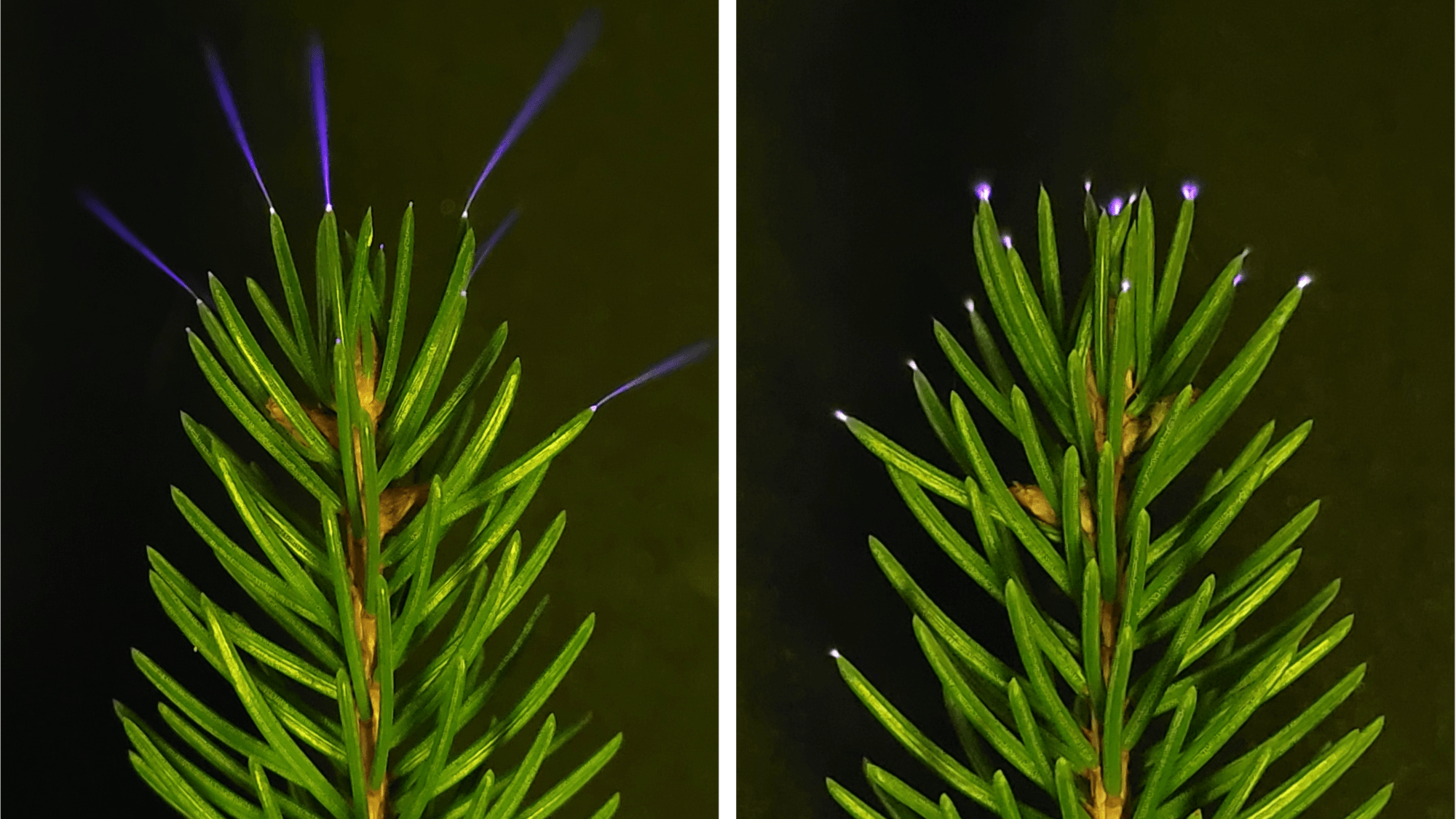
For the first time, scientists have captured evidence of a phenomenon long theorized but never observed: during thunderstorms, the tips of leaves emit weak electrical discharges known as coronae, creating an ethereal blue glow. This discovery was made by researchers who spotted these faint emissions on spruce needles during a storm in North Carolina in 2024. The glowing coronae, which are too dim for human eyes to see, can also damage leaf tips and potentially harm entire tree canopies. These findings, published in the journal Geophysical Research Letters, provide new insights into how thunderstorms interact with plant life.
The phenomenon occurs when the powerful electric fields of thunderstorms induce opposite charges in the ground below. These ground charges then travel toward the highest points—such as the tips of leaves—and discharge through the trees, forming coronae. This process has been observed in laboratory experiments for decades, but it was only during a real storm that scientists were able to capture concrete evidence using specialized equipment. The researchers modified a Toyota Sienna minivan with sensors and a UV-sensitive camera to detect these emissions under stormy skies.
The discovery not only confirms decades of theoretical work but also raises important questions about the impact of thunderstorms on tree health. Electrical discharges can damage cell membranes and destroy chloroplasts, which are essential for photosynthesis. This could have significant implications for forest ecosystems, as frequent storms might shape tree evolution to minimize such damage. The study highlights a previously unknown connection
Verticals
sciencetech
Originally published on Popular Science on 2/25/2026