
Satellite spies northern lights over Iceland and Canada | Space photo of the day for Feb. 23, 2026
Space.com
by Daisy Dobrijevic February 23, 2026
AI-Generated Deep Dive Summary
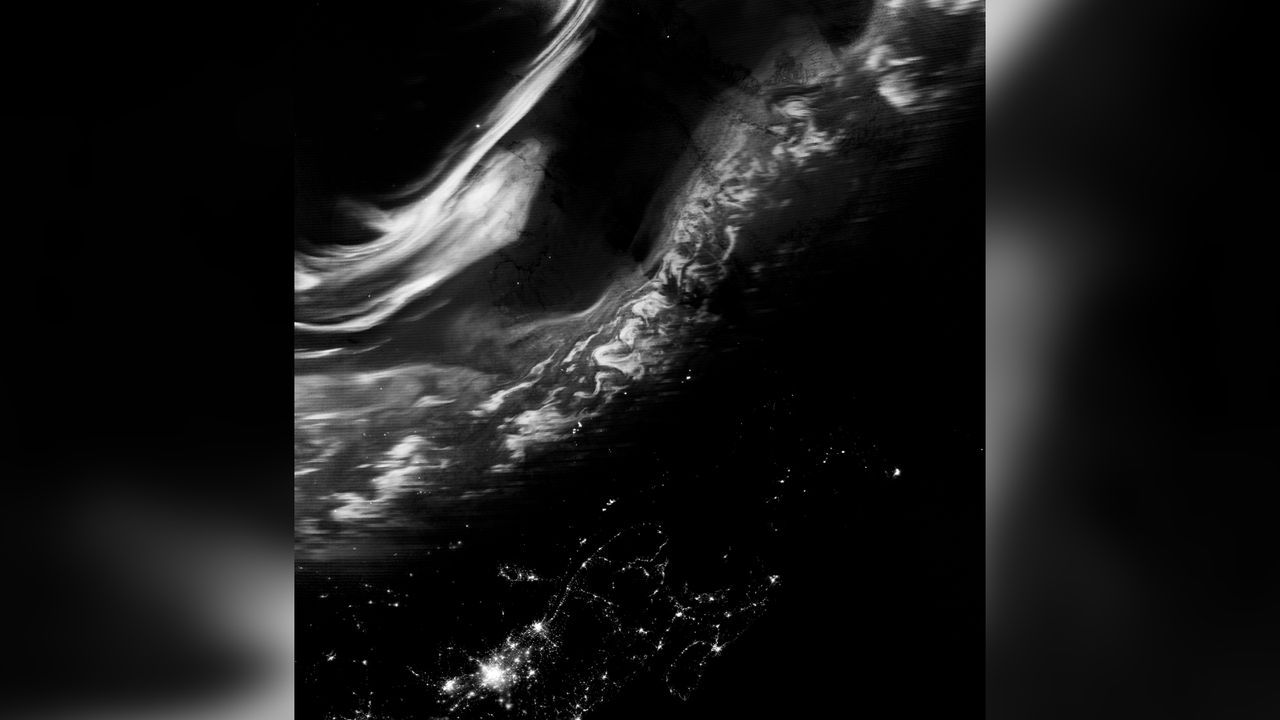
A satellite captured breathtaking images of the northern lights over Iceland and eastern Canada during a G1 geomagnetic storm on February 16, 2026. The Suomi National Polar-Orbiting Partnership's VIIRS day-night band provided grayscale imagery showing auroras shimmering over the Denmark Strait and stretching across parts of Quebec and Newfoundland. Despite being minor on the five-level geomagnetic scale, the G1 storm produced vivid displays of green, red, and purple lights due to favorable conditions.
Geomagnetic storms occur when charged particles from solar wind or coronal mass ejections interact with Earth's magnetic field, funneling energetic particles toward the poles. These particles collide with atmospheric gases at different altitudes, creating colorful auroras. Green lights are most common, appearing between 60-90 miles high when oxygen molecules are struck. Red hues emerge at higher altitudes (180-250 miles) from the same process, while blue and purple tones occur lower down, around 60 miles or less, due to nitrogen interactions.
The satellite images revealed auroras stretching over Greenland and Iceland at 11:45 p.m. EST and above Canada later that night, with city lights like Montreal visible in the background. While satellites capture these phenomena in grayscale, ground observers would have seen dynamic ribbons of green with occasional reds and purples. Such events are particularly significant for space enthusiasts and astrotourists, who eagerly chase opportunities to witness nature's light show.
This event highlights the beauty and scientific importance of solar activity and space weather. For readers interested in space phenomena, these images offer a glimpse into Earth's dynamic interaction with the sun and its impact on our atmosphere. The study of geomagnetic storms also aids in understanding space weather, which can affect satellite operations, power grids, and communication systems.
Verticals
spacescience
Originally published on Space.com on 2/23/2026