
Starlight warped in the fabric of spacetime could help us find hidden black holes dancing together
Space.com
by Keith Cooper February 24, 2026
AI-Generated Deep Dive Summary
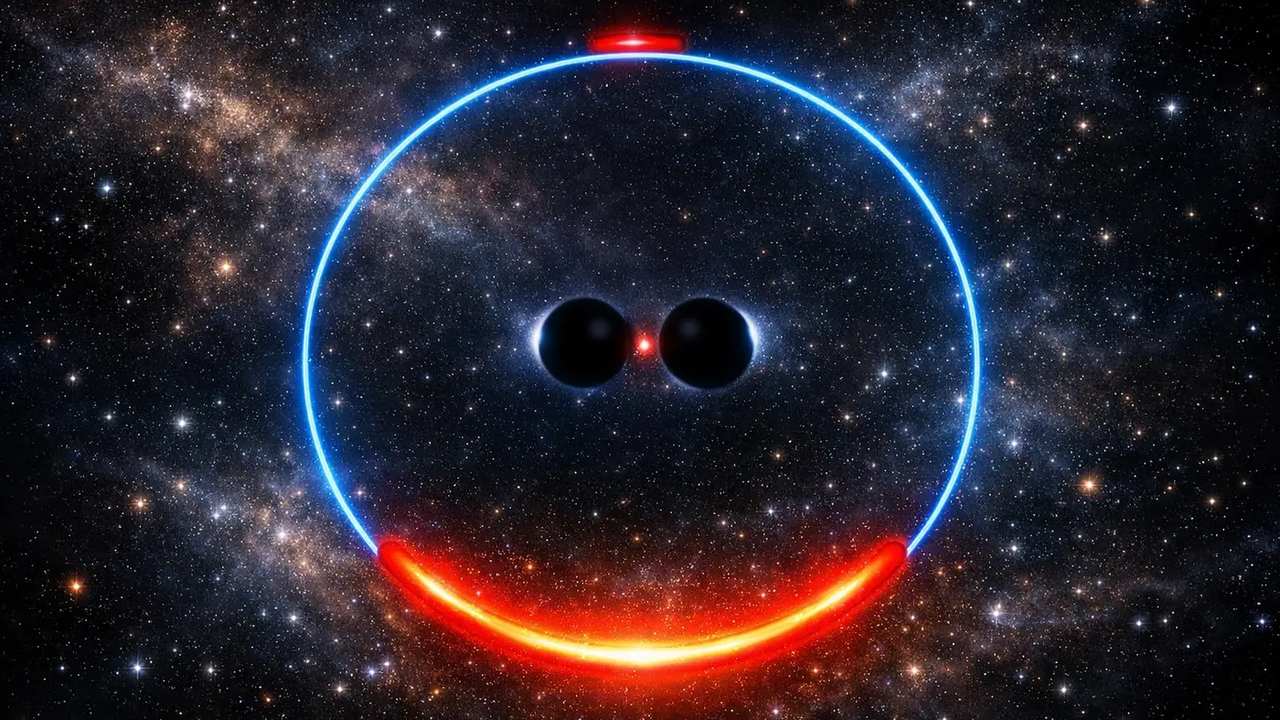
A groundbreaking discovery could soon reveal hidden supermassive black hole binaries to astronomers by leveraging the bending of starlight through gravitational lensing. Researchers have found that binary black holes—pairs of massive black holes orbiting each other—create a unique "caustic curve" that amplifies light from background stars when they align with it. This phenomenon produces periodic flashes of brightness, offering a clear signal of their presence long before space-based gravitational wave detectors like LISA can detect their merging.
The study highlights how binary black holes act as dual lenses, warping spacetime around them and creating a diamond-shaped zone where light is magnified. Unlike single black holes, which require precise alignment with a star to produce lensing effects, binaries significantly increase the chances of detecting amplified starlight. As the black holes orbit each other, their caustic curve shifts, sweeping across a region of stars behind them. If a bright star lies within this path, it can create intense flashes of light lasting several years—equal to the orbital period of the black holes. These repeating bursts serve as a distinctive signature of a binary supermassive black hole system.
This method offers a promising way to identify such binaries years before their gravitational waves are detectable. The research also opens new possibilities for multi-messenger astronomy, combining visual observations with future gravitational wave detections. By studying these systems, scientists can gain deeper insights into the dynamics of massive black holes and test theories of gravity in extreme conditions. This breakthrough could transform our understanding of galaxy evolution and the cosmic dance of supermassive black holes.
Verticals
spacescience
Originally published on Space.com on 2/24/2026