
Supermassive serial killers: Astronomers discover how black holes 'kill off' neighboring galaxies
Space.com
by Robert Lea February 20, 2026
AI-Generated Deep Dive Summary
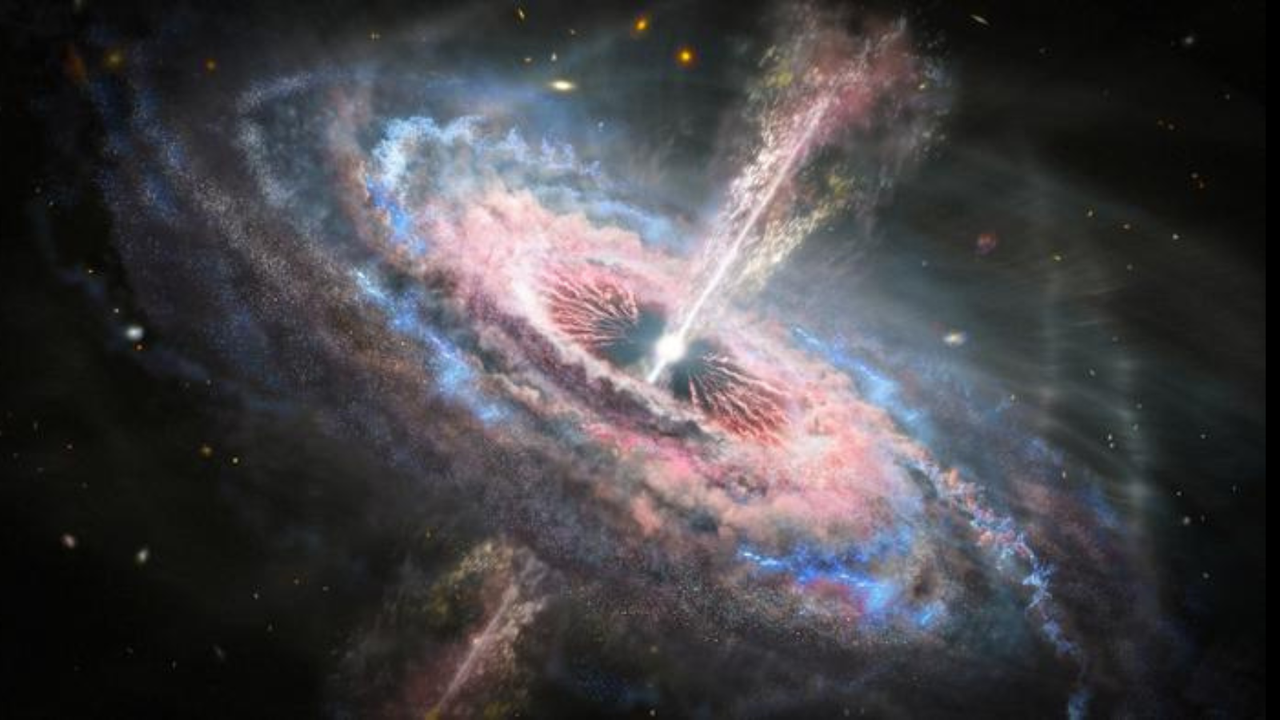
Scientists have discovered that supermassive black holes, particularly those in their active phases, can act like cosmic serial killers, not only affecting their host galaxies but also influencing neighboring galaxies far beyond their immediate vicinity. When an active supermassive black hole feeds on a swirling disk of gas and dust—known as an accretion disk—it emits intense radiation and powerful jets of matter that travel near light-speeds. This activity can suppress star formation in surrounding galaxies by heating or scattering the essential building blocks of stars, thereby stifling their growth.
The study highlights that these black holes, found at the centers of large galaxies, play a significant role in shaping their galactic neighborhoods. For instance, quasars—extremely bright and active supermassive black holes—often appear isolated because their intense radiation and jets suppress star formation in nearby galaxies, making it difficult to detect recent or ongoing starbirth activity there.
Using observations from the James Webb Space Telescope, researchers noted a curious pattern: the most massive and powerful quasars seem to have fewer neighboring galaxies. This led them to suspect that these supermassive black holes might not only impact their own galaxies but also disturb nearby ecosystems by suppressing star formation. The findings suggest a complex interplay between active black holes and their galactic surroundings, potentially reshaping our understanding of how galaxies evolve.
This research underscores the profound influence of supermassive black holes on the cosmic ecosystem. By revealing how these massive objects can suppress star formation in neighboring galaxies, scientists gain new insights into the interconnected dynamics of galaxies and their central engines. For readers interested in space, this study offers a glimpse into the violent yet intricate processes that shape the universe we observe today.
Verticals
spacescience
Originally published on Space.com on 2/20/2026