
'The beacons were lit!' Scientists name merging supermassive black holes after 'Lord of the Rings'…
Space.com
by Robert Lea February 13, 2026
AI-Generated Deep Dive Summary
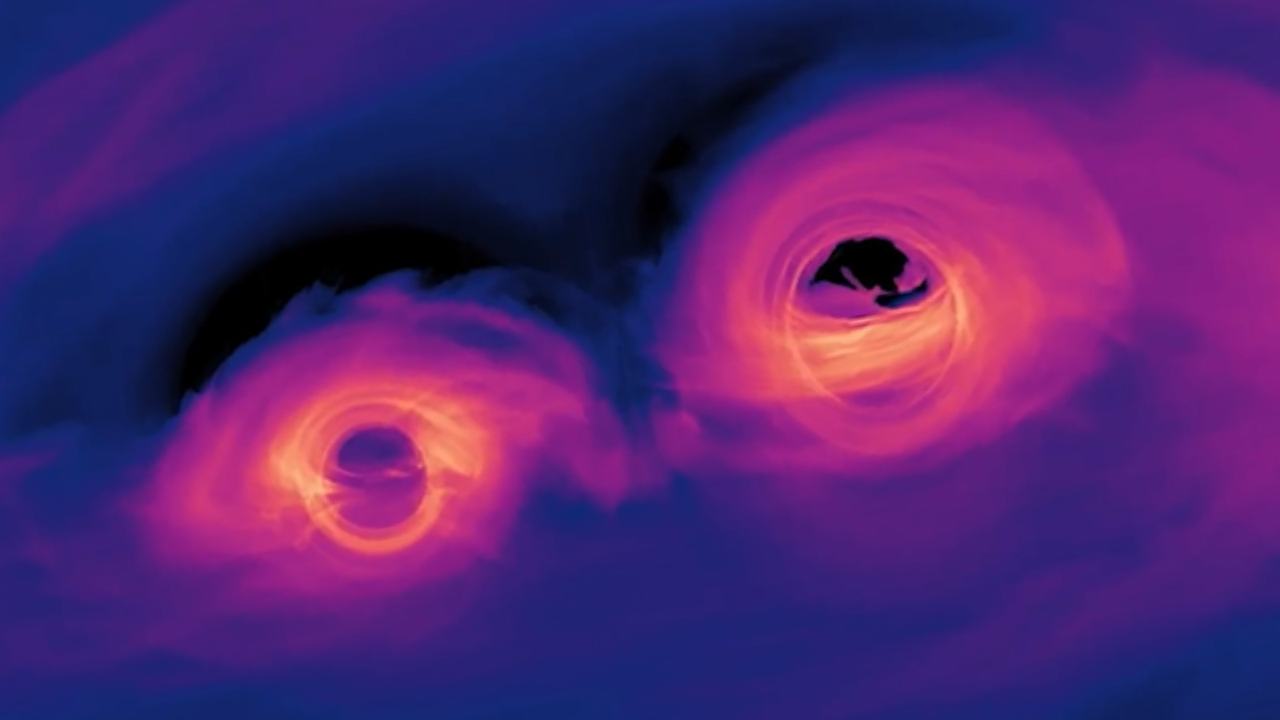
Scientists have made a groundbreaking discovery by identifying supermassive black hole binaries using gravitational waves, naming them after iconic locations from "The Lord of the Rings." The technique involves detecting signals resembling lit beacons, which indicate merging black holes. This method offers a promising way to map these cosmic events and understand galaxy mergers and black hole physics.
The names "Rohan" and "Gondor" were chosen with inspiration from both pop culture and personal recognition. Rohan honors Yale student Rohan Shivakumar, who led the initial analysis, while Gondor references the lit beacons in Tolkien's work that called for aid. This creative approach highlights the blend of science and culture in modern research.
The NANOGrav team detected a gravitational wave background in 2023 and is now systematically searching for more supermassive black hole binaries. Their findings, published in *The Astrophysical Journal Letters*, outline a framework for detecting these mergers, which could help create a detailed map of merging black holes across the universe.
Understanding these events is crucial as they provide insights into galaxy evolution and gravitational wave physics. This research not only advances our knowledge of space but also opens new avenues for studying the cosmos through gravitational waves, offering an alternative perspective beyond traditional light-based observations.
The study underscores the importance of gravitational waves in exploring the universe's most enigmatic phenomena. By detecting these cosmic beacons, scientists hope to unlock deeper secrets about black holes and their role in shaping galaxies, making this a pivotal area of research for space enthusiasts.
Verticals
spacescience
Originally published on Space.com on 2/13/2026