
Why are there so many 'space snowmen' in our solar system? New study offers clues
Space.com
by Charles Q. Choi February 26, 2026
AI-Generated Deep Dive Summary
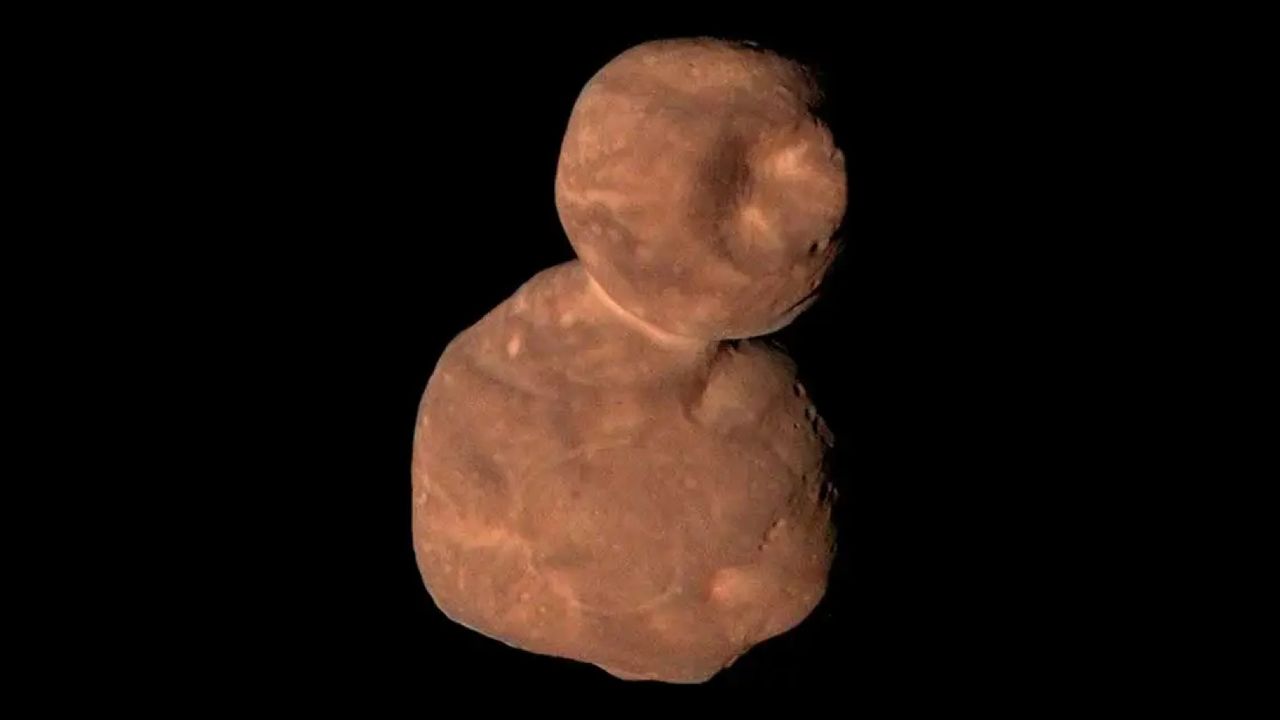
NASA’s New Horizons spacecraft has revealed mysterious icy objects in the solar system that resemble snowmen—pairs of conjoined spheres known as contact binaries. These peculiar shapes, found among Kuiper Belt planetesimals beyond Neptune, have long puzzled scientists. A groundbreaking new study offers fresh insights into their formation, challenging previous theories that relied on perfect mergers of spherical bodies.
The research models planetesimals not as single particles but as clouds of smaller pebbles interacting gravitationally. When these spinning clusters lose rotational energy, they can form binary systems where two separate objects orbit each other. Over time, mutual gravitational pull causes them to gently fuse, resulting in unique shapes like snowmen, cigars, or flat disks. The study highlights how the speed at which these planetesimals move and the strength with which their particles interlock determine their final forms.
While simulations show that only 4% of planetesimals form contact binaries, this figure doesn’t align perfectly with observations suggesting a higher rate. The researchers attribute this discrepancy to limitations in their models, such as particle count and size ranges. Enhancing these parameters or exploring the formation of triple systems could yield more accurate
Verticals
spacescience
Originally published on Space.com on 2/26/2026